


DC Brushed Motor
What is DC Brushed Motor?
A DC Brushed Motor is an internally commutated electric motor designed to be run from a direct current power source and utilizing an electric brush for contact. A DC Brushed Motor has permanent magnets inside its outer body with a rotating armature inside. The permanent magnets are stationary and are called the 'stator'. The rotating armature contains an electromagnet and is called the 'rotor'. In a DC Brushed Motor, the rotor spins 180-degrees when an electric current is applied to the armature. In order to travel beyond the initial 180 degrees, the poles of the electromagnet must flip. Carbon brushes contact the stator as the rotor spins, flipping the magnetic field and enabling the rotor to spin 360-degrees. DC Brushed Motors can be varied in speed by changing the operating voltage or the strength of the magnetic field. Depending on the connections of the field to the power supply, the speed and torque characteristics of a DC Brushed Motor can be altered to provide steady speed or speed inversely proportional to the mechanical load. DC Brushed Motors continue to be used for electrical propulsion, cranes, paper machines and steel rolling mills.
Why Choose Us?
Rich Experience
Sunroad Motor has been specializing in the development and production of DC motors for over three decades. As a professional manufacturer of DC motors, it is also an authoritative micro-motor engineering technology center certified by relevant institutions.
Professional Team
The company has established a comprehensive team of 160 professionals dedicated to production, research and development, and management. Equipped with advanced facilities, the team is capable of independently designing and developing products tailored to customer requirements.
Quality Assurance
All our products undergo rigorous quality control processes and have received official certifications, including ISO9001 system certification, CE certification, and UL certification. Additionally, we hold numerous patents that reflect our commitment to innovation and excellence.
Broad Market
Our products are exported to Europe, America, and major cities across China. We maintain long-term, stable partnerships with leading customers in the industry on a global scale, ensuring consistent satisfaction and trust.


Advantages of DC Brushed Motor
DC Brushed Motor has many advantages over AC power, which makes it ideal for various applications such as data centers, telecommunication facilities including cell sites, hospitals, airports, railway stations, and industrial facilities. DC Brushed Motor is becoming increasingly popular due to the rise of renewable energy sources, electric vehicles, and telecommunication devices. Here are some advantages of DC Brushed Motor:
Reliability: The use of DC Brushed Motor in telecom systems helps reduce power outage risks and increases network reliability.
Efficiency: DC Brushed Motor is more efficient than AC power because it does not waste energy in the form of heat. This makes it ideal for high-power applications such as data centers, electric vehicles, or heavy machinery.
Stability: DC Brushed Motor provides stable and predictable voltages, which is crucial for sensitive equipment such as microprocessors and machine drives.
Scalability: DC Brushed Motor can be easily scaled up or down to meet the specific needs of a particular application. This makes it suitable for both large-scale and small-scale projects.
Energy Storage: DC Brushed Motor can be stored for future use in its current form directly into back up batteries without the need for any type of conversion which makes it an ideal source of power for critical applications that require uninterruptable power like cell sites and data centers, as well as off-grid systems like solar panels and wind turbines. DC Brushed Motor is also becoming increasingly popular in electric vehicles as it enables faster charging times, greater efficiency, and longer battery life.
What Are the Fundamentals of Dc Brushed Motor?
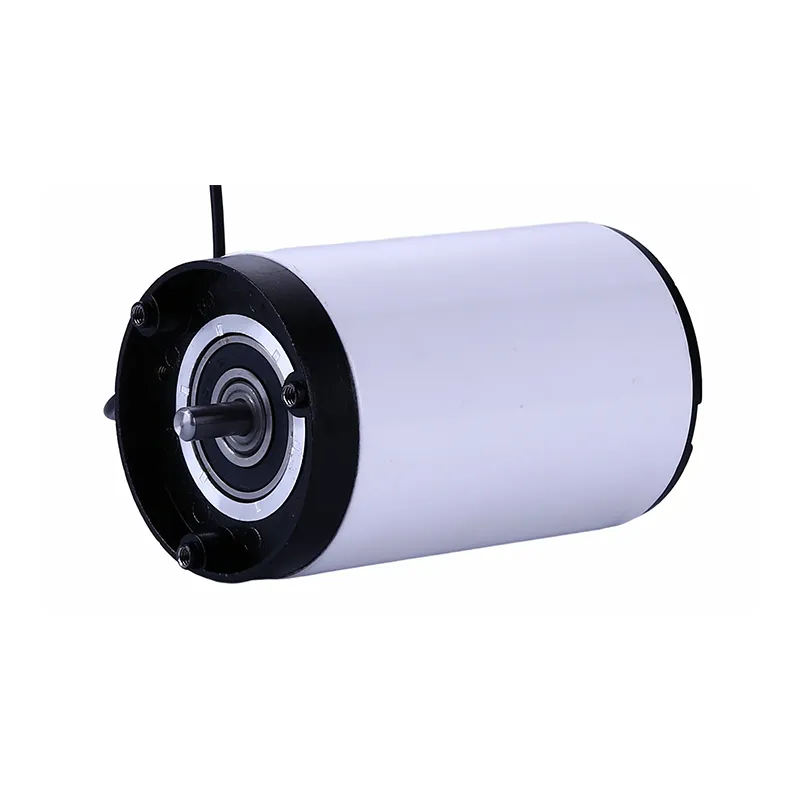
DC Brushed Motor does this through the interaction between magnets, one of which is typically created by passing a current through wire bound around a ferrite core. The current flowing through the wire generates the second magnetic field. This interacts with the primary magnetic field to create an opposing force that moves one part of the DC Brushed Motor, usually causing it to rotate around an axle.
DC Brushed Motors consist of four key components; the stationary magnet (called a stator), the rotor, the commutator and the brushes. The rotor consists of one or more windings of wire wrapped around a core made of a ferrous metal, usually iron, and connected to power with a metal "brush". When we send current through the rotor windings, the field generated interacts with the stator's field and creates the force that turns the rotor. The stator can be a permanent magnet or electromagnet, depending on the requirements of any particular application.
That's all very well but if we just used regular wires to connect the rotor windings to the power supply, once the rotor has turned far enough its magnetic force would effectively reverse direction – so the rotor would just move back and forth, instead of rotating in one direction.
To fix this we use the commutator, which is a conductive copper sleeve around the axle of the rotor, physically and electrically divided into segments. As the commutator rotates it connects and disconnects these segments through the brushes, applying power to different pairs of segments. This causes the polarity of the magnetic field to reverse each time the DC Brushed Motor rotates 180º, resulting in smooth and continuous rotation.
Applications of DC Brushed Motor
The applications of different types of DC Brushed Motors are listed below:
Owing to the fairly constant speed and medium starting torque of shunt DC Brushed Motors, they are used in the following applications:
• Centrifugal and reciprocating pumps
• Lathe machines
• Blowers and Fans
• Drilling machines
• Milling machines
• Machine tools
Owing to the high starting torque and variable speed of series DC Brushed Motors, they are used in the following applications:
• Conveyors
• Hoists, Elevators
• Cranes
• Electric Locomotives
Owing to the high starting torque of cumulative compound DC Brushed Motors, they are used in the following applications:
• Shears
• Heavy Planers
• Rolling mills
• Elevators
Types of DC Brushed Motors
There are 3 main types of DC Brushed Motor that are available: Series, Shunt and Compound. These terms relate to the type of connection of the field windings with respect to the armature circuit.
1. DC Series Motors
A DC series motor will have its field windings connected in series with the armature. The series winding will have relatively few turns of larger wire or copper strip which are capable of carrying the full load current of the motor. On starting, because the windings are low resistance, a large current can be drawn producing a high starting torque.
This is an advantage for high starting loads such as traction, crane and other heavy applications. The speed of a series motor is dependent on the load, so when the full load current flowing through the circuit has reduced, the speed will have increased.
In some instances, the DC Brushed Motors speed could potentially increase to a level above the recommended maximum. For this reason, a series motor should not be connected to its load with a belt.
2. DC Shunt Motors
In a DC Shunt motor the field winding is connected in parallel (shunt) with the armature. The shunt winding is wound from many turns of small copper wire and since it is connected across the DC field supply, its field current will be constant.
The DC Brushed Motor will run up to rated speed and this will not be greatly affected by a change in load. The starting torque will be less than a similar sized series motor but if this is not required then a constant speed shunt motor may be preferable for the application.
DC shunt motors can be used for many applications such as plastics or wire extrusion.
3. DC Compound Motors
With a DC compound motor, the majority of the field is wound for a shunt field but with a few turns of series winding on top. The shunt is connected across the field supply and the series turns are connected in series with the armature. This provides a motor with a combination of the shunt and series characteristics.
The starting torque will be higher than a shunt motor but not as high as a series motor. The speed will change with load and the amount will depend on the % of field space allocated to the series winding. The series field can be arranged to either increase or decrease the speed with load. Applications for these DC Brushed Motors vary but are often for larger applications such as unwind brake generators, conveyors, mixers etc.
A form of DC compound motor can also be used where the supply is from batteries with a wide range of volts. In this instance both the field and armature have the same voltage applied and by using the compound winding this helps to keep the speed within an acceptable range.
Drive Circuits for DC Brushed Motors
A DC Brushed Motor does not require an external controller, as the change of magnetic field polarity is implemented through the brushes making and breaking the electrical pathway through the windings, achieving continuous rotation in one direction.
For some applications, that's good enough. But if we want to be able to change the speed of the DC Brushed Motor, or reverse the direction of rotation, we need a drive circuit. This can be as simple as just reversing the direction of current flow to make the DC Brushed Motor turn the other way.
To change speed we could alter the voltage, using a potential divider – with speed being proportional to voltage. However, reducing the voltage in this way is inefficient, as a voltage divider does not reduce the total current flowing. To overcome this, pulse width modulation (PWM) is often used, which involves rapidly switching the current off and on to reduce the 'average' voltage across the DC Brushed Motor.

Construction of Dc Brushed Motor?

It typically consists of a pair of permanent magnets named as the stator and a DC Brushed Motor coil named as the rotor connected to a commutator. In this DC Brushed Motor, armature winding is on rotar and permanent magnets are always on the stator. The current-carrying conductors always locates on the turning part. practically, these conductors get power from direct current power source. It uses metallic brushes (which rotate along with the rotor) to transfer the current to the coil. Though these DC Brushed Motors are quite efficient but they require periodic maintenance of brushes.
How to Choose DC Brushed Motor?
Motor diameter: Sizing a DC Brushed Motor to a specific application begins with matching the motor's diameter to the available space. In general, larger frame size DC Brushed Motors deliver more torque. DC Brushed Motor diameter ranges from 8 mm to 35 mm.
Length: Various lengths are available, ranging from 16.6 mm to 67.2 mm, to best fit the application package requirements.
3. Commutation type
Commutation type: DC Brushed Motors are well adapted to low current density applications, providing low friction and high efficiency, whereas high continuous or peak current applications will require graphite-copper brushes.
Bearing type: Several bearing combinations have been designed, from simple sleeve bearing construction to preloaded ball bearings systems for high axial or radial load applications.
Magnet and commutation type: Adapt your DC Brushed Motor selection to the power and current needs of your application magnets provide higher output torque than Alnico, at a higher cost. The commutation system (type and size of the commutators) is also reflected in this coding.
Winding: Various winding options are proposed to best match with the application requirements – voltage, resistance and torque constant are the basic parameters for selection.
Execution code: Used to specify standard and customizations.
Our Factory
Zhejiang Sanrong Electric Motor Co., Ltd. was established in 1986 and has been deeply involved in DC motors for more than 30 years. It is a professional manufacturer of DC motors and an authoritative certified micro motor engineering technology center. In order to meet the needs of customers and the market, the company invested 20 million yuan in 2000 to establish a modern factory in Ningbo with an area of 22000 square meters. We have established a production, research and development, and management team of 160 people. Our mature research and development team and professional testing and research and development equipment enable us to independently design and develop products according to customer needs. Professional automation equipment greatly improves our production capacity to meet the order needs of domestic and foreign customers.


Ultimate FAQ Guide to DC Motor
Q: What are the criteria for DC Brushed Motor selection?
Q: How do you control the speed of a DC Brushed Motor?
Q: What is the difference between a brushed DC motor and a DC motor?
Q: How do I know which DC Brushed Motor to use?
Q: What is the life expectancy of a DC Brushed Motor?
DC Brushed Motors on average achieve a service life of 1000-3000 hours whereas brushless motors should be able to achieve 20000 hours providing they are operated within their specification. The output speed is also a key factor when choosing a brushed or brushless motor.
Q: What Are the Fundamentals of Dc Brushed Motor?
Q: How to choose brushed DC motor?
• Motor diameter.
• Length.
• Commutation type.
• Bearing type.
• Magnet and commutation type.
• Winding.
• Execution code.
Q: What happens if you run DC Brushed Motor at lower voltage?
Q: Why are DC Brushed Motors better?
Q: Do DC Brushed Motors last longer than AC motors?
• DC Brushed Motors usually require much more maintenance and have a shorter lifespan than AC motors. This is because the brushes that press against the spinning commutator experience wear and tear, requiring regular maintenance and replacement.
• DC Brushed Motors and AC induction motors, on the other hand, do not have parts that rub against each other, which means that they’re quieter and require less maintenance.
Q: Can a DC Brushed Motor be used as a generator?
Q: Can you control the rpm of a DC Brushed Motor?
Q: Do DC Brushed Motors require more maintenance than AC motors?
Q: What Do AC and DC Mean?
Q: Construction of DC Brushed Motor?
Q: Can DC motors be 3-phase?
Q: Where are DC Brushed Motors used?
Q: How efficient is a DC brushed motor?
Q: How do you calculate the horsepower of a DC Brushed Motor?
Q: What is DC Brushed Motor?
Zhejiang Sanrong Electric Motor Co., Ltd. is one of the most professional dc brushed motor manufacturers and suppliers in China, providing high quality customized service with reasonable price. We warmly welcome you to buy dc brushed motor for sale here and get quotation from our factory.
linear actuator dc motor, DC Gear Motor, Marine Water Pump 12V DC MOTOR