

The starting current of a Permanent Magnet DC (PMDC) motor is a crucial parameter that significantly impacts its performance, efficiency, and overall lifespan. As a trusted PMDC motor supplier, we understand the importance of this aspect and are committed to providing in - depth knowledge to our customers.
Understanding the Basics of a PMDC Motor
Before delving into the starting current, it's essential to understand the fundamental working principle of a PMDC motor. A PMDC motor consists of a permanent magnet stator and a wound rotor. When a voltage is applied across the motor terminals, an electric current flows through the rotor windings. This current creates a magnetic field that interacts with the magnetic field of the permanent magnet stator, resulting in a torque that causes the rotor to rotate.
What is Starting Current?
The starting current of a PMDC motor is the current drawn by the motor at the instant when it starts from a stand - still position. At startup, the motor has zero rotational speed, which means there is no back - electromotive force (back - EMF) generated. Back - EMF is a voltage that opposes the applied voltage and is proportional to the motor's speed. According to Ohm's law, (I=\frac{V - E}{R}), where (I) is the current, (V) is the applied voltage, (E) is the back - EMF, and (R) is the armature resistance. When the motor is at rest ((E = 0)), the current is simply (I=\frac{V}{R}). Since the armature resistance (R) of a PMDC motor is relatively low, the starting current can be several times higher than the rated current of the motor.
Factors Affecting Starting Current
- Applied Voltage: The starting current is directly proportional to the applied voltage. A higher applied voltage will result in a higher starting current. For example, if the armature resistance of a motor is (R = 1\Omega) and the applied voltage is (V = 12V), the starting current (I=\frac{12}{1}=12A). If the applied voltage is increased to (24V), the starting current will double to (I=\frac{24}{1}=24A).
- Armature Resistance: A lower armature resistance leads to a higher starting current. Motors with lower resistance can conduct more current for a given applied voltage. Manufacturers can design motors with different armature resistances depending on the application requirements.
- Load Inertia: The inertia of the load connected to the motor also affects the starting current. A high - inertia load requires more torque to start rotating, which in turn requires a higher current. For instance, a motor driving a heavy flywheel will draw a higher starting current compared to a motor driving a light - weight fan.
Consequences of High Starting Current
- Overheating: High starting current can cause excessive heating of the motor windings. This can lead to insulation damage and reduce the motor's lifespan. Prolonged exposure to high starting currents can also cause thermal stress on the motor components, leading to mechanical failures.
- Voltage Drop: In a power system, a high starting current can cause a significant voltage drop. This can affect the performance of other electrical devices connected to the same power source. For example, in a household electrical system, a large PMDC motor starting can cause the lights to dim temporarily.
- Fuse Blowing and Circuit Breaker Tripping: If the starting current exceeds the rated current of the fuses or circuit breakers in the electrical circuit, they may blow or trip. This can disrupt the operation of the motor and the entire electrical system.
Methods to Reduce Starting Current
- Soft - Start Devices: Soft - start devices gradually increase the voltage applied to the motor over a period of time. This reduces the initial current surge and allows the motor to start smoothly. For example, a solid - state soft - starter can control the voltage using thyristors or transistors.
- External Resistance: Adding an external resistance in series with the armature during startup can limit the starting current. Once the motor reaches a certain speed, the external resistance can be gradually removed. This method is simple but may result in power losses in the external resistance.
- PWM Control: Pulse - Width Modulation (PWM) control can be used to control the average voltage applied to the motor. By varying the duty cycle of the PWM signal, the average voltage and hence the starting current can be controlled.
Applications and Considerations
PMDC motors are widely used in various applications, including automotive, robotics, and consumer electronics. In automotive applications, such as power windows and windshield wipers, the starting current needs to be carefully controlled to avoid draining the battery and causing electrical problems. In robotics, the starting current can affect the stability and accuracy of the robot's movements.
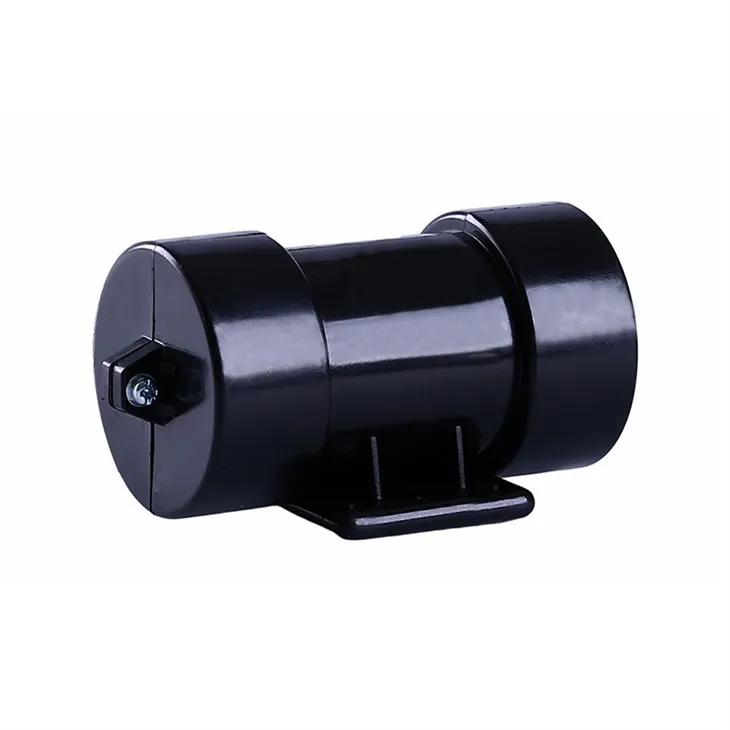

When selecting a PMDC motor for an application, it's important to consider the starting current requirements. For applications where a high starting torque is required, a motor with a relatively high starting current may be acceptable, as long as the power supply and the electrical system can handle it. On the other hand, for applications where a smooth start and low power consumption are crucial, methods to reduce the starting current should be employed.
We offer a wide range of PMDC motors, including Vibration Dc Motor, Push Rod DC Motor, and 24V DC Water Pump Motor. Our motors are designed with high - quality materials and advanced manufacturing techniques to ensure reliable performance and optimal starting current characteristics.
If you are in the market for PMDC motors and have specific requirements regarding starting current or other performance parameters, we invite you to contact us for a detailed discussion. Our team of experts is ready to assist you in selecting the right motor for your application and provide you with the best solutions.
References
- Fitzgerald, A. E., Kingsley, C., & Umans, S. D. (2003). Electric Machinery (6th ed.). McGraw - Hill.
- Chapman, S. J. (2012). Electric Machinery Fundamentals (5th ed.). McGraw - Hill.
- Nasar, S. A., & Boldea, I. (1997). Electric Machines and Drives: A First Course. Prentice Hall.